Page 25 - Glasbenopedagoški zbornik Akademije za glasbo v Ljubljani / The Journal of Music Education of the Academy of Music in Ljubljana: Mostovi med formalnim in neformalnim glasbenim izobraževanjem, leto 15, zvezek 31 / Year 15, Issue 31, 2019
P. 25
Ana Èoriæ, DEVELOPING COMMUNITY MUSIC ACTIVITIES IN HIGHER EDUCATION...
myself, the full participation in the program and collaboration with the students meant a lot
for me as a facilitator. Besides the program itself, I went to explore some artistic ideas and
workshop formats by myself, volunteering alone in one of the children’s libraries. One of
the ideas I managed to explore, but we still didn’t make to realize in the bigger format, was
to develop a story with a concert band, so that children can be on the real stage.3
To conceptualize the process, the further text is divided into several parts: (1) Changing
contexts and audiences; (2) Art and Pedagogy; (3) Interviews with students and (4)
Research conclusions. Each part is focusing on the different part of the program
development. Research conclusions gather all the insights from the process.
Changing contexts and audiences
At the beginning of the program, the initial idea was to make sounded stories for visually
impaired children in the Vinko Bek Center (institution for education and rehabilitation of
visually impaired children, youth and adults). First workshops were organized for visually
impaired children with learning disabilities in one of the children’s libraries of Zagreb
City Libraries. Although the space in the library had really good potential, those first
gatherings showed a certain impracticability with carriage of children and their assistants
from the Center to the library, as well as with the space itself. Since the library is situated at
one of the city markets, the noise from outside was too big. Furthermore, since this was the
space unfamiliar to the children, we decided to move activities back to the Vinko Bek
Center, in their home atmosphere where they move freely and where it is not necessary
that each child has a personal assistant. One more reason which contributed to our decision
was that in the Center we had numerous instruments we could use in our workshops.
However, the collaboration with libraries stayed and expanded on audience who can see,
which opened numerous possibilities for the community development, as well as music
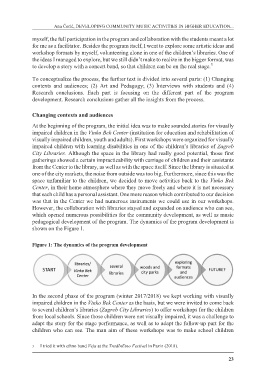
pedagogical development of the program. The dynamics of the program development is
shown on the Figure 1.
Figure 1: The dynamics of the program development
In the second phase of the program (winter 2017/2018) we kept working with visually
impaired children in the Vinko Bek Center as the basis, but we were invited to come back
to several children’s libraries (Zagreb City Libraries) to offer workshops for the children
from local schools. Since those children were not visually impaired, it was a challenge to
adapt the story for the stage performance, as well as to adapt the follow-up part for the
children who can see. The man aim of these workshops was to make school children
3 I tried it with ethno band Veja at the TradInEtno Festival in Pazin (2018).
23
myself, the full participation in the program and collaboration with the students meant a lot
for me as a facilitator. Besides the program itself, I went to explore some artistic ideas and
workshop formats by myself, volunteering alone in one of the children’s libraries. One of
the ideas I managed to explore, but we still didn’t make to realize in the bigger format, was
to develop a story with a concert band, so that children can be on the real stage.3
To conceptualize the process, the further text is divided into several parts: (1) Changing
contexts and audiences; (2) Art and Pedagogy; (3) Interviews with students and (4)
Research conclusions. Each part is focusing on the different part of the program
development. Research conclusions gather all the insights from the process.
Changing contexts and audiences
At the beginning of the program, the initial idea was to make sounded stories for visually
impaired children in the Vinko Bek Center (institution for education and rehabilitation of
visually impaired children, youth and adults). First workshops were organized for visually
impaired children with learning disabilities in one of the children’s libraries of Zagreb
City Libraries. Although the space in the library had really good potential, those first
gatherings showed a certain impracticability with carriage of children and their assistants
from the Center to the library, as well as with the space itself. Since the library is situated at
one of the city markets, the noise from outside was too big. Furthermore, since this was the
space unfamiliar to the children, we decided to move activities back to the Vinko Bek
Center, in their home atmosphere where they move freely and where it is not necessary
that each child has a personal assistant. One more reason which contributed to our decision
was that in the Center we had numerous instruments we could use in our workshops.
However, the collaboration with libraries stayed and expanded on audience who can see,
which opened numerous possibilities for the community development, as well as music
pedagogical development of the program. The dynamics of the program development is
shown on the Figure 1.
Figure 1: The dynamics of the program development
In the second phase of the program (winter 2017/2018) we kept working with visually
impaired children in the Vinko Bek Center as the basis, but we were invited to come back
to several children’s libraries (Zagreb City Libraries) to offer workshops for the children
from local schools. Since those children were not visually impaired, it was a challenge to
adapt the story for the stage performance, as well as to adapt the follow-up part for the
children who can see. The man aim of these workshops was to make school children
3 I tried it with ethno band Veja at the TradInEtno Festival in Pazin (2018).
23