Page 45 - Glasbenopedagoški zbornik Akademije za glasbo, letnik 16, zvezek 33 ◆ The Journal of Music Education of the Academy of Music in Ljubljana, year 16, issue 33
P. 45
eral characteristics of music education in primary j. martinović bogojević ◆ musical creativity in primary school programmes for music education in montenegro and slovenia
schools in montenegro and slovenia
Systems of primary education in Montenegro and Slovenia can be analysed
through their numerous similarities, resulting from the reform of the edu-
cational system in Montenegro, which began in 2001 and which took as its
primary model the Slovenian education system. In music education, similar-
ities were, primarily, related to the definition of musical activities, operation-
al goals, didactic recommendations and teaching outcomes within three three-
year cycles (Predmetni program Muzička kultura,1 2003).2
Music education is present, in both educational systems, as an obligato-
ry subject during all nine years of primary school. The legal framework, both
in Montenegro and Slovenia, offers the specialist teacher a possibility to teach
music from the fourth grade of primary school onwards.3
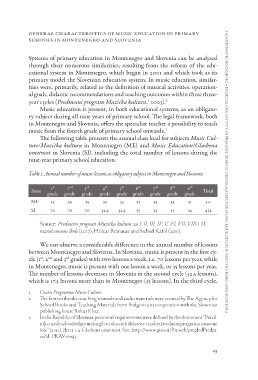
The following table presents the annual class load for subjects Music Cul-
ture/Muzička kultura in Montenegro (ME) and Music Education/Glasbena
umetnost in Slovenia (SI), including the total number of lessons during the
nine-year primary school education.
Table 1: Annual number of music lessons as obligatory subject in Montenegro and Slovenia
State 1st 2nd 3rd. 4th 5th 6th 7th 8th 9th Total
grade grade grade grade grade grade grade grade grade
ME 311
SI 35 35 35 35 35 35 35 35 31 452
70 70 70 52,5 52,5 35 35 35 32
Source: Predmetni program Muzička kultura za I, II, III, IV, V, VI, VII, VIII i IX
razred osnovne škole (2017); Holcar Branauer and Sicherl Kafol (2011).
We can observe a considerable difference in the annual number of lessons
between Montenegro and Slovenia. In Slovenia, music is present in the first cy-
cle (1st, 2nd and 3rd grades) with two lessons a week, i.e. 70 lessons per year, while
in Montenegro, music is present with one lesson a week, or 35 lessons per year.
The number of lessons decreases in Slovenia in the second cycle (52.5 lessons),
which is 17.5 lessons more than in Montenegro (35 lessons). In the third cycle,
1 Course Programme Music Culture.
2 The first textbooks, teaching manuals and audio materials were created by The Agency for
School Books and Teaching Materials from Podgorica in cooperation with the Slovenian
publishing house Rokus Klett.
3 In the Republic of Slovenia, personnel requirements were defined by the document “Pravil-
nik o izobrazbi učiteljev in drugih strokovnih delavcev v izobraževalnem programu osnovne
šole” (2011), člen 1.1.4. Glasbena umetnost. See: http://www.pisrs.si/Pis.web/pregledPredpi-
sa?id=PR AV10943.
45
schools in montenegro and slovenia
Systems of primary education in Montenegro and Slovenia can be analysed
through their numerous similarities, resulting from the reform of the edu-
cational system in Montenegro, which began in 2001 and which took as its
primary model the Slovenian education system. In music education, similar-
ities were, primarily, related to the definition of musical activities, operation-
al goals, didactic recommendations and teaching outcomes within three three-
year cycles (Predmetni program Muzička kultura,1 2003).2
Music education is present, in both educational systems, as an obligato-
ry subject during all nine years of primary school. The legal framework, both
in Montenegro and Slovenia, offers the specialist teacher a possibility to teach
music from the fourth grade of primary school onwards.3
The following table presents the annual class load for subjects Music Cul-
ture/Muzička kultura in Montenegro (ME) and Music Education/Glasbena
umetnost in Slovenia (SI), including the total number of lessons during the
nine-year primary school education.
Table 1: Annual number of music lessons as obligatory subject in Montenegro and Slovenia
State 1st 2nd 3rd. 4th 5th 6th 7th 8th 9th Total
grade grade grade grade grade grade grade grade grade
ME 311
SI 35 35 35 35 35 35 35 35 31 452
70 70 70 52,5 52,5 35 35 35 32
Source: Predmetni program Muzička kultura za I, II, III, IV, V, VI, VII, VIII i IX
razred osnovne škole (2017); Holcar Branauer and Sicherl Kafol (2011).
We can observe a considerable difference in the annual number of lessons
between Montenegro and Slovenia. In Slovenia, music is present in the first cy-
cle (1st, 2nd and 3rd grades) with two lessons a week, i.e. 70 lessons per year, while
in Montenegro, music is present with one lesson a week, or 35 lessons per year.
The number of lessons decreases in Slovenia in the second cycle (52.5 lessons),
which is 17.5 lessons more than in Montenegro (35 lessons). In the third cycle,
1 Course Programme Music Culture.
2 The first textbooks, teaching manuals and audio materials were created by The Agency for
School Books and Teaching Materials from Podgorica in cooperation with the Slovenian
publishing house Rokus Klett.
3 In the Republic of Slovenia, personnel requirements were defined by the document “Pravil-
nik o izobrazbi učiteljev in drugih strokovnih delavcev v izobraževalnem programu osnovne
šole” (2011), člen 1.1.4. Glasbena umetnost. See: http://www.pisrs.si/Pis.web/pregledPredpi-
sa?id=PR AV10943.
45