Page 50 - Glasbenopedagoški zbornik Akademije za glasbo, letnik 16, zvezek 33 ◆ The Journal of Music Education of the Academy of Music in Ljubljana, year 16, issue 33
P. 50
sbenopedagoški zbornik ◆ letnik 16 ◆ številka 33 The above table (SI) shows that the descriptions of activities are similar to
those in the Montenegrin programme and that they are realistically set with re-
gard to the number of lessons. Invention of musical symbols, organised by pu-
pils into meaningful units is absent in the programmes in Montenegro. This goal
seems logical, as it develops creativity through creation of notation. Image sym-
bols for tone marking are used in the first cycle of music education in both sys-
tems. In this way, pupils can connect the visual with the auditive, gradually under-
standing the meaning of symbols (movement of melody, pitch and tone duration).
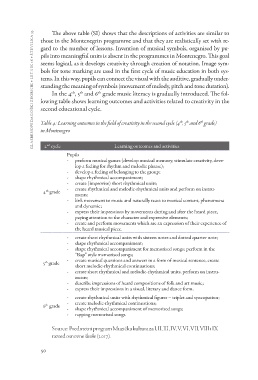
In the 4th, 5th and 6th grade music literacy is gradually introduced. The fol-
lowing table shows learning outcomes and activities related to creativity in the
second educational cycle.
Table 4: Learning outcomes in the field of creativity in the second cycle (4th, 5th and 6th grade)
in Montenegro
2nd cycle Learning outcomes and activities
4th grade Pupils
- perform musical games (develop musical memory, stimulate creativity, deve-
5th grade
6th grade lop a feeling for rhythm and melodic phrase);
- develop a feeling of belonging to the group;
- shape rhythmical accompaniment;
- create (improvise) short rhythmical units;
- create rhythmical and melodic-rhythmical units and perform on instru-
ments;
- link movement to music and naturally react to musical content, phenomena
and dynamic;
- express their impressions by movements during and after the heard piece,
paying attention to the character and expressive elements;
- create and perform movements which are an expression of their experience of
the heard musical piece.
- create short rhythmical units with sixteen notes and dotted quarter note;
- shape rhythmical accompaniment;
- shape rhythmical accompaniment for memorised songs; perform in the
“Rap” style memorised songs;
- create musical questions and answers in a form of musical sentence, create
short melodic-rhythmical continuations;
- create short rhythmical and melodic-rhythmical units, perform on instru-
ments;
- describe impressions of heard compositions of folk and art music;
- express their impressions in a visual, literary and dance form.
- create rhythmical units with rhythmical figures – triplet and syncopation;
- create melodic-rhythmical continuations;
- shape rhythmical accompaniment of memorised songs;
- rapping memorised songs.
Source: Predmetni program Muzička kultura za I, II, III, IV, V, VI, VII, VIII i IX
razred osnovne škole (2017).
50
those in the Montenegrin programme and that they are realistically set with re-
gard to the number of lessons. Invention of musical symbols, organised by pu-
pils into meaningful units is absent in the programmes in Montenegro. This goal
seems logical, as it develops creativity through creation of notation. Image sym-
bols for tone marking are used in the first cycle of music education in both sys-
tems. In this way, pupils can connect the visual with the auditive, gradually under-
standing the meaning of symbols (movement of melody, pitch and tone duration).
In the 4th, 5th and 6th grade music literacy is gradually introduced. The fol-
lowing table shows learning outcomes and activities related to creativity in the
second educational cycle.
Table 4: Learning outcomes in the field of creativity in the second cycle (4th, 5th and 6th grade)
in Montenegro
2nd cycle Learning outcomes and activities
4th grade Pupils
- perform musical games (develop musical memory, stimulate creativity, deve-
5th grade
6th grade lop a feeling for rhythm and melodic phrase);
- develop a feeling of belonging to the group;
- shape rhythmical accompaniment;
- create (improvise) short rhythmical units;
- create rhythmical and melodic-rhythmical units and perform on instru-
ments;
- link movement to music and naturally react to musical content, phenomena
and dynamic;
- express their impressions by movements during and after the heard piece,
paying attention to the character and expressive elements;
- create and perform movements which are an expression of their experience of
the heard musical piece.
- create short rhythmical units with sixteen notes and dotted quarter note;
- shape rhythmical accompaniment;
- shape rhythmical accompaniment for memorised songs; perform in the
“Rap” style memorised songs;
- create musical questions and answers in a form of musical sentence, create
short melodic-rhythmical continuations;
- create short rhythmical and melodic-rhythmical units, perform on instru-
ments;
- describe impressions of heard compositions of folk and art music;
- express their impressions in a visual, literary and dance form.
- create rhythmical units with rhythmical figures – triplet and syncopation;
- create melodic-rhythmical continuations;
- shape rhythmical accompaniment of memorised songs;
- rapping memorised songs.
Source: Predmetni program Muzička kultura za I, II, III, IV, V, VI, VII, VIII i IX
razred osnovne škole (2017).
50