Page 51 - Glasbenopedagoški zbornik Akademije za glasbo, letnik 16, zvezek 33 ◆ The Journal of Music Education of the Academy of Music in Ljubljana, year 16, issue 33
P. 51
le 5: Operational goals in the field of creativity for the second cycle (4th, 5th and 6th grade) j. martinović bogojević ◆ musical creativity in primary school programmes for music education in montenegro and slovenia
in Slovenia
2nd cycle - Operational goals
Pupils
- by singing and/or rhythmically expression, supplement and create musical contents and
forms;
- by singing create different kinds of tones;
- by rhythmical expression, create one-, two- or polyphonic contents and forms;
- create the same, similar and different units. By instruments they supplement and create
different musical contents and forms (form of a song, cannon, rondo, theme, variation);
- with instruments, they create different kinds of tones;
- by movement-dance, visually and verbally they express musical and non-musical experien-
ces and images;
- present, perform and assess their achievements;
- express a special dedication to music and musical expression.
Source: Program osnovna šola glasbena umetnost. Učni načrt (2011, p. 8).
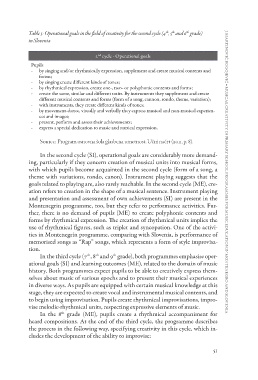
In the second cycle (SI), operational goals are considerably more demand-
ing, particularly if they concern creation of musical units into musical forms,
with which pupils become acquainted in the second cycle (form of a song, a
theme with variations, rondo, canon). Instrument playing suggests that the
goals related to playing are, also rarely reachable. In the second cycle (ME), cre-
ation refers to creation in the shape of a musical sentence. Instrument playing
and presentation and assessment of own achievements (SI) are present in the
Montenegrin programme, too, but they refer to performance activities. Fur-
ther, there is no demand of pupils (ME) to create polyphonic contents and
forms by rhythmical expression. The creation of rhythmical units implies the
use of rhythmical figures, such as triplet and syncopation. One of the activi-
ties in Montenegrin programme, comparing with Slovenia, is performance of
memorised songs as “Rap” songs, which represents a form of style improvisa-
tion.
In the third cycle (7th, 8th and 9th grade), both programmes emphasise oper-
ational goals (SI) and learning outcomes (ME), related to the domain of music
history. Both programmes expect pupils to be able to creatively express them-
selves about music of various epochs and to present their musical experiences
in diverse ways. As pupils are equipped with certain musical knowledge at this
stage, they are expected to create vocal and instrumental musical contents, and
to begin using improvisation. Pupils create rhythmical improvisations, impro-
vise melodic-rhythmical units, respecting expressive elements of music.
In the 8th grade (ME), pupils create a rhythmical accompaniment for
heard compositions. At the end of the third cycle, the programme describes
the process in the following way, specifying creativity in this cycle, which in-
cludes the development of the ability to improvise:
51
in Slovenia
2nd cycle - Operational goals
Pupils
- by singing and/or rhythmically expression, supplement and create musical contents and
forms;
- by singing create different kinds of tones;
- by rhythmical expression, create one-, two- or polyphonic contents and forms;
- create the same, similar and different units. By instruments they supplement and create
different musical contents and forms (form of a song, cannon, rondo, theme, variation);
- with instruments, they create different kinds of tones;
- by movement-dance, visually and verbally they express musical and non-musical experien-
ces and images;
- present, perform and assess their achievements;
- express a special dedication to music and musical expression.
Source: Program osnovna šola glasbena umetnost. Učni načrt (2011, p. 8).
In the second cycle (SI), operational goals are considerably more demand-
ing, particularly if they concern creation of musical units into musical forms,
with which pupils become acquainted in the second cycle (form of a song, a
theme with variations, rondo, canon). Instrument playing suggests that the
goals related to playing are, also rarely reachable. In the second cycle (ME), cre-
ation refers to creation in the shape of a musical sentence. Instrument playing
and presentation and assessment of own achievements (SI) are present in the
Montenegrin programme, too, but they refer to performance activities. Fur-
ther, there is no demand of pupils (ME) to create polyphonic contents and
forms by rhythmical expression. The creation of rhythmical units implies the
use of rhythmical figures, such as triplet and syncopation. One of the activi-
ties in Montenegrin programme, comparing with Slovenia, is performance of
memorised songs as “Rap” songs, which represents a form of style improvisa-
tion.
In the third cycle (7th, 8th and 9th grade), both programmes emphasise oper-
ational goals (SI) and learning outcomes (ME), related to the domain of music
history. Both programmes expect pupils to be able to creatively express them-
selves about music of various epochs and to present their musical experiences
in diverse ways. As pupils are equipped with certain musical knowledge at this
stage, they are expected to create vocal and instrumental musical contents, and
to begin using improvisation. Pupils create rhythmical improvisations, impro-
vise melodic-rhythmical units, respecting expressive elements of music.
In the 8th grade (ME), pupils create a rhythmical accompaniment for
heard compositions. At the end of the third cycle, the programme describes
the process in the following way, specifying creativity in this cycle, which in-
cludes the development of the ability to improvise:
51